
Connections, Insights, and Inspiration: Stories from The Reading League North Carolina at TRLConf25
The Reading League, a national nonprofit organization, hosts an annual conference for educators, researchers, and other collaborators to learn about evidence-aligned reading instruction and the science of reading. The conference includes keynote sessions, sessions from well-known literacy experts and researchers, and networking opportunities to deepen our understanding of reading instruction.
Earlier this month, four of our board members attended The Reading League National Conference in Chicago.
They attended the Chapter Leader Retreat and worked on storytelling skills to further our mission. They learned about the power of oral storytelling with expert facilitators from The Moth. A key piece of this style of storytelling is speaking WITHOUT notes. Chapter leaders in attendance collaborated with others from across the nation.
Each board member attended keynote and breakout sessions that best supported their learning. Keep reading to hear from them.
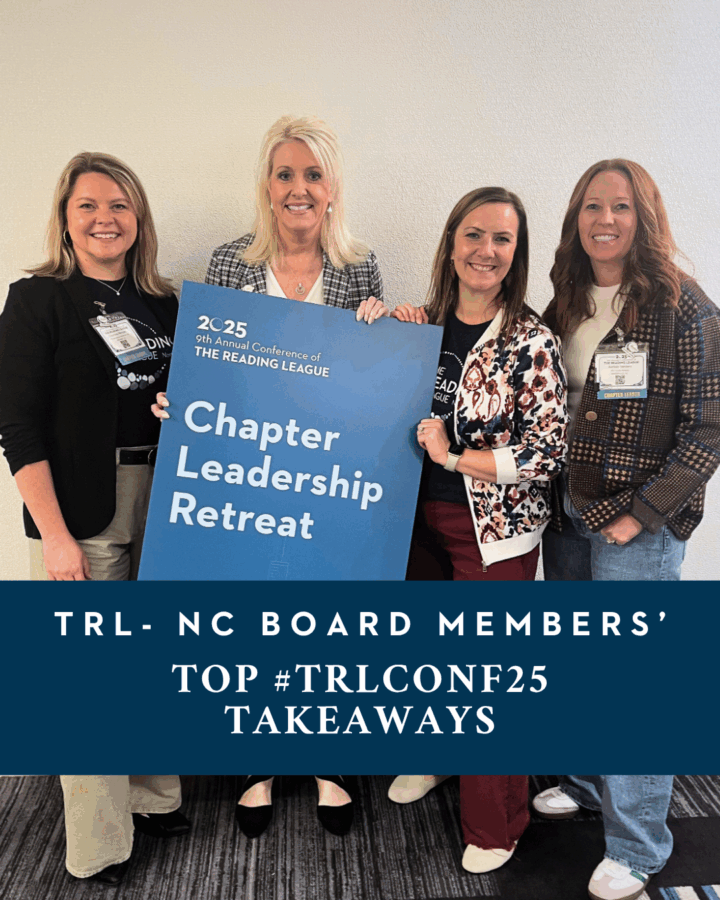
Pictured from left to right: Courtney Morgan, Kim Collins, Linda Rhyne, Ashton Venters
Which session or speaker has made the biggest impression on you and why?
- Kim Collins – Hilderbrand Pelzer provided research that 85% of all juveniles who interface with the juvenile court system are functionally illiterate. We have the power to help change literacy instruction and reduce the “school to prison pipeline.”
- Courtney Morgan – Dr. Marisa Ramirez Stukey: Deepening Implementation of the Science of Reading through the Science of Learning. This presentation brought to light many of the cognitive and non-cognitive factors that come into play when teaching reading. These factors aren’t represented in many of our well-known reading models, but they are so essential for reaching every learner! As a multilingual learner specialist, this session was particularly impactful for me. Each of our students is so unique in his or her strengths and areas of need, and educators should couple our Science of Reading-aligned practices with awareness of the Science of Learning.
- Ashton Venters – Anita Archer- Delivery of Explicit Instruction: High Leverage Practice that Promote Engagement and Learning; She made learning extremely engaging with a lot of advice for how to keep teachers and students active and engaged in learning.
- Linda Rhyne – Leveraging Structured Literacy for Multilingual Learners with Lacey Robinson, Dale W. Webster & Maya Valencia Goodall: “We don’t ‘do the science of reading.’ We do structured literacy that is grounded in the science of reading.” This quote addressed the common practice of turning ‘the science of reading” into something small such as implementing phonics. The speakers instead highlighted the definition of the Science of Reading, reminding us that our instructional practices are those of structured literacy, grounded in this evidence-based research. It was a helpful reminder and referenced IDA’s structured literacy resources.
What’s one idea, strategy, or piece of research you can’t wait to take back to your school, district, or organization?
- Kim Collins – From Dr. Ioulia Kovelman: “The brain is a muscle exercised by bilingualism . . . Bilingual proficiency strengthens functional connectivity between brain regions that support language and literacy.” We have more and more students who are bilingual, and it’s exciting to have the opportunity to capitalize on their strengths.
- Courtney Morgan – The first part of Dr. Stukey’s presentation that struck me as very important for my pre-service teachers (and all teachers of reading) had to do with what learning models inform our instructional practice. We often rely heavily on the Simple View of Reading (Gough and Tunmer, 1986), Scarborough’s Rope (2001), and others to provide foundational models that support our reading instruction. While they are truly valuable, we need to explore additional models that address the other factors that impact a reader on any given day. Dr. Stukey shared results of two major studies (Foorman et al., 2018, and Quinn & Wagner, 2018) that examined how much of children’s reading comprehension ability can be explained by the Simple View of Reading (SVR). The studies found that the SVR explains only about half to two-thirds of comprehension outcomes — suggesting additional factors (like motivation, working memory, attention, socio-emotional factors, and executive function) matter significantly. In other words, there are a lot of reading issues that cannot be explained or identified by just the elements in the SVR.
- Ashton Venters – Reminders around reading engagement
- Linda Rhyne – In Dr. Adrea Truckenmiller’s I was struck by the importance of understanding sentences, but not at the sentence level. Rather, deepening our understanding of sentence structures supports our understanding of an entire text. And there is a range of difficulty, a continuum if you will, that helps to predict the difficulty of sentences that then make connections across a text more difficult. This is in addition to the number of long words predicting difficulty of text. What the findings point to is spending less time diagramming sentences or teaching parts of speech, rather focusing on the function of them within a full text. It behooves us to spend time on addressing full text structure (orally) and thinking across the text.
What’s one change you’re inspired to make because of #TRLConf2025?
- Kim Collins – Hilderbrand Pelzer reminded all of us of the critical importance of continuing to work as hard as we can to help ensure that students leave our schools with the literacy skills needed to be successful in life.
- Courtney Morgan – As I introduce various models of reading to teacher candidates, I will include models that help us unpack and integrate the Science of Learning. We’ll discuss the immense value of recognizing that–as Dr. Stukey reminded us– “the head and the heart grow together.”
- Ashton Venters – Providing more modeling and explicit examples of high leverage practices that promote engagement.
- Linda Rhyne – I am inspired from Dr. Amanda VanDerHeyden’s session to continue weaving the Instructional Hierarchy into my work; both in how we support adults and implementation, and helping educators use it to support their instructional planning.
What was your favorite moment of connection or inspiration at the conference?
- Kim Collins – Dr. Julie Washington shared that we should “invite [multilingual] students to deploy their full linguistic repertoire” when making meaning of instruction. It was a good reminder that we should acknowledge the power of translanguaging, which she says is a “dynamic use of all linguistic resources.” According to Dr. Washington, translanguaging increases student engagement and promotes a deeper and fuller understanding of the subject being taught due to a deeper understanding of the material.
- Courtney Morgan – One of my passions is advocating for equitable literacy instruction for multilingual learners. It was exciting and encouraging to see several sessions and incredible presenters centering on the unique needs of ML students. I loved learning from them and making new connections!
- Ashton Venters – I got a chance to talk with Dr. Archer about curriculum. So much advice around selection and next steps.
- Linda Rhyne – I loved learning with Viv Ramakrishnan, Co-Founder and CEO of Project Read AI. His insights into how we can leverage emerging technologies while acknowledging its limits alleviated some of my skepticism about ed tech in this journey. He is a thoughtful leader who is diligently working to support students and teachers in this incredibly difficult work.